


Last updated on October 15th, 2026 at 12:49 am
GHK-Cu has attracted scientific interest for decades because it combines a short amino acid sequence with copper-binding chemistry. Researchers have investigated this copper-peptide complex in studies involving molecular interactions, cellular signaling, extracellular matrix biology, oxidative processes, and experimental tissue models. More recent research has also examined how formulation and analytical methods affect the identity and stability of copper-peptide systems.
For peptide science, GHK-Cu offers an important case study in how a molecule’s chemical structure can influence the interpretation of experimental results. Its research history spans basic coordination chemistry, laboratory models, formulation science, and a smaller body of human research. These areas do not provide the same level of evidence, making it important to distinguish laboratory findings from established clinical conclusions.
This article reviews GHK-Cu chemistry, selected scientific developments, analytical characterization, and the questions researchers are investigating. It also explains why identifying the actual copper-peptide complex is important when interpreting published results.
What Is GHK-Cu?
GHK-Cu is a copper-containing peptide complex formed from GHK, a tripeptide whose amino acid sequence is glycine, histidine, and lysine. The name refers to the three amino acids and their association with copper, commonly described in research as a copper(II) complex.
GHK and GHK-Cu are related but chemically distinct entities. GHK is the peptide ligand, while GHK-Cu refers to the copper-associated form. This distinction matters because a study involving the unbound peptide does not automatically establish the same behavior for the copper complex. Researchers interested in laboratory research materials can buy GHK-Cu from PharmaGrade Peptides and review the available product specifications and documentation before sourcing.
Researchers have examined GHK because of its copper-binding properties and its presence in biological systems. The addition of copper creates a coordination complex in which the metal ion interacts with specific atoms in the peptide.
A foundational review, GHK Peptide as a Natural Modulator of Multiple Cellular Pathways in Skin Regeneration, describes the chemistry and biological research that helped establish GHK-Cu as a subject of continued investigation. The review also summarizes research into cellular pathways and extracellular matrix biology.
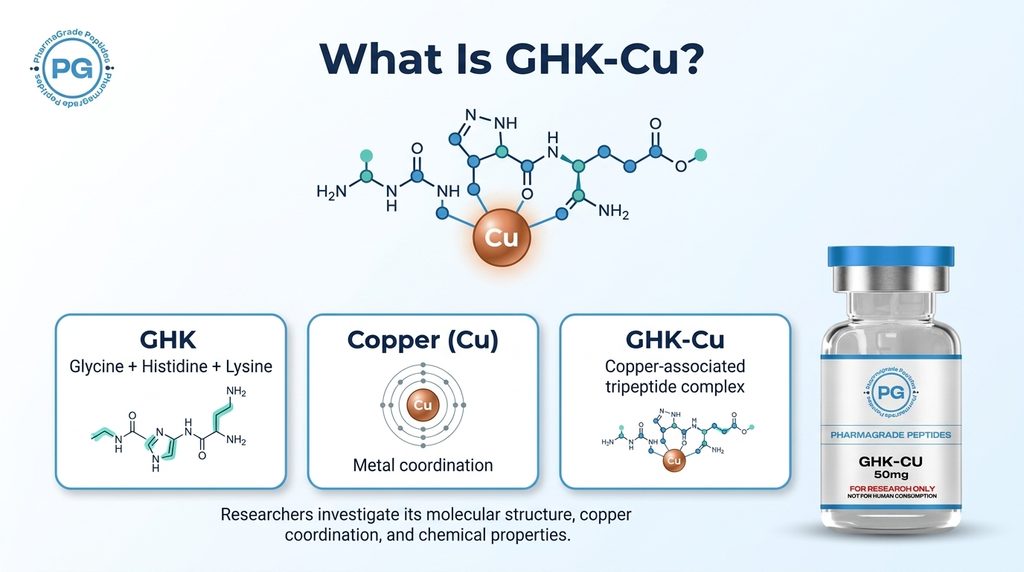
Source: GHK Peptide as a Natural Modulator of Multiple Cellular Pathways in Skin Regeneration.
The Chemistry Behind the Copper-Peptide Complex
Understanding GHK-Cu begins with coordination chemistry: the study of how metal ions interact with molecules that can donate electron pairs.
In this system, copper is not simply mixed with a peptide as an unrelated ingredient. The metal ion interacts with specific sites on the peptide, creating a coordinated molecular structure. The precise arrangement can depend on the chemical environment, including pH, competing ligands, and solution conditions.
The role of glycine, histidine, and lysine
Each amino acid contributes to the overall peptide structure, but histidine is especially important because its imidazole side chain can coordinate metal ions.
Research on copper-GHK structures has used several complementary techniques, including X-ray crystallography, electron paramagnetic resonance spectroscopy, X-ray absorption spectroscopy, and nuclear magnetic resonance methods. These techniques help researchers investigate how copper is coordinated and how the complex behaves in different environments.
A 2011 structural study published in Chemistry: A European Journal examined copper(II) complexes of GHK and a related peptide. Its findings showed that the observed coordination arrangements can differ between solid-state structures and solution conditions.
This is an important point for analytical research: a structure observed in a crystal does not necessarily describe every molecular species present in a solution.
Source: X-ray and Solution Structures of Cu(II) GHK and Cu(II) DAHK Complexes.
Why copper coordination matters
Metal coordination can affect a complex’s structure, stability, electronic properties, and interactions with other molecules. For GHK-Cu, these characteristics are relevant to understanding the results of both chemical experiments and biological investigations.
However, researchers should avoid treating all copper-peptide formulations as interchangeable. Differences in copper availability, ligand composition, formulation, and environmental conditions may affect the chemical species present during an experiment.
This means that knowing a sample contains GHK and copper is not always sufficient to establish the exact identity or proportions of the complexes present.
GHK-Cu and Copper Binding: What Computational Research Shows
Computational chemistry provides another way to investigate GHK-Cu. Instead of relying exclusively on physical measurements, researchers can use molecular mechanics, quantum-chemical calculations, and simulations to explore possible structures and interactions.
A 2020 study by Alshammari and Platts examined copper binding to GHK using several computational approaches, including density functional theory and molecular dynamics.
The researchers investigated possible conformations and the geometry of copper coordination. Their simulations supported a coordination arrangement involving nitrogen and oxygen atoms and examined how the complex behaved over a short molecular-dynamics trajectory.
The study is useful because it illustrates how computational models can complement experimental structural chemistry. Calculations can help researchers compare possible structures and identify questions that may be tested through laboratory measurements.
However, computational results have limitations. A molecular simulation does not independently establish biological activity, long-term stability, or the behavior of a formulation under every experimental condition.
Source: Theoretical Study of Copper Binding to GHK Peptide.
Current GHK-Cu Research: Important Areas of Investigation
GHK-Cu research covers several connected fields. These include basic metal-binding chemistry, cellular models, extracellular matrix research, formulation development, and analytical characterization.
The strongest interpretation of this literature comes from considering the type of evidence behind each finding rather than treating every published result as equally conclusive.
1. Extracellular matrix and cellular signaling research
The extracellular matrix is a network of molecules surrounding cells. It helps provide structural support and participates in processes that regulate cellular behavior.
Researchers have investigated GHK-related compounds in experimental models involving matrix components, gene expression, and cellular signaling. These studies have contributed to interest in how GHK-Cu interacts with biological systems.
Much of this literature involves laboratory experiments or preclinical models. Such research can identify mechanisms worth investigating, but findings from cells or animals do not automatically establish the same effects in humans.
For this reason, articles about GHK-Cu should distinguish between a proposed biological mechanism and a demonstrated clinical outcome.
2. Oxidative and inflammatory pathways
Another area of investigation involves oxidative processes and signaling pathways associated with inflammation.
The chemistry of copper makes this area particularly complex. Copper can participate in electron-transfer reactions, and its effects depend on its oxidation state, coordination environment, and availability. The behavior of a copper-peptide complex therefore cannot be inferred from the presence of copper alone.
Researchers investigating GHK-Cu must consider whether the observed effect is associated with the intact complex, the peptide itself, copper released from the complex, or a combination of factors.
This is one reason suitable controls and detailed chemical characterization are important in mechanistic studies.
3. Formulation and delivery research
A growing area of peptide science examines how formulations affect the identity, stability, and movement of compounds through experimental systems.
For GHK-Cu, researchers have investigated delivery approaches involving materials such as hydrogels, liposomes, polymers, and other carrier systems. These technologies raise important analytical questions: does the formulation preserve the intended copper-peptide complex, and can the researchers measure what is released?
A formulation may change the behavior of a compound without necessarily improving every relevant outcome. Carrier materials can also have independent effects, making appropriate comparison groups essential.
A 2026 review in Pharmaceutics specifically examines GHK-Cu as a bioactive metallopeptide and a potential drug-delivery cargo. It highlights the importance of distinguishing chemical identity, copper coordination, formulation quality, and biological evidence.
Source: GHK-Cu as a Bioactive Metallopeptide and Drug-Delivery Cargo.
4. Skin-related experimental research
GHK-Cu has also been investigated in skin-related laboratory models and a limited number of human studies. The research literature includes work on cellular processes, cosmetic formulations, and experimental delivery systems.
These studies should not be interpreted as proof that every GHK-Cu product will produce the same results. Research findings depend on the material tested, its formulation, the study design, and the endpoints measured.
A 2026 systematic review of GHK-Cu in aesthetic medicine identified a relatively small evidence base for standalone GHK-Cu interventions and noted limitations in the available clinical literature.
Source: The Regenerative Potential of GHK-Cu in Aesthetic Medicine.
The central research question is not simply whether GHK-Cu has been studied. It is how consistently the available evidence identifies the tested material and supports the conclusions drawn from each experiment.
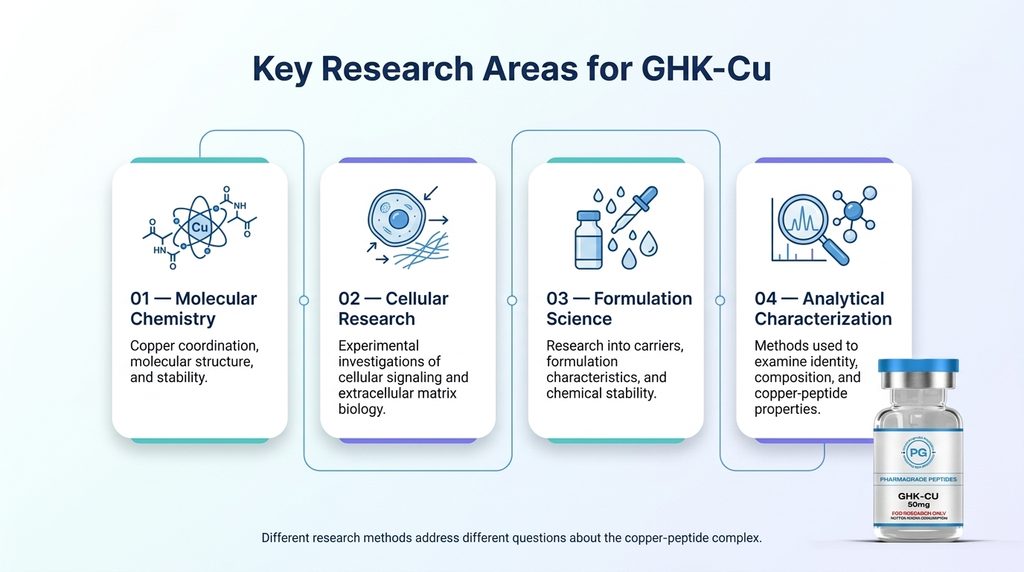
Why Analytical Characterization Is Important
Analytical characterization helps researchers establish what a sample contains and whether its properties match the intended specifications.
For a copper-peptide complex, the task may require more than a single measurement. Researchers need to consider peptide identity, related impurities, copper association, sample composition, and the limitations of the analytical methods used.
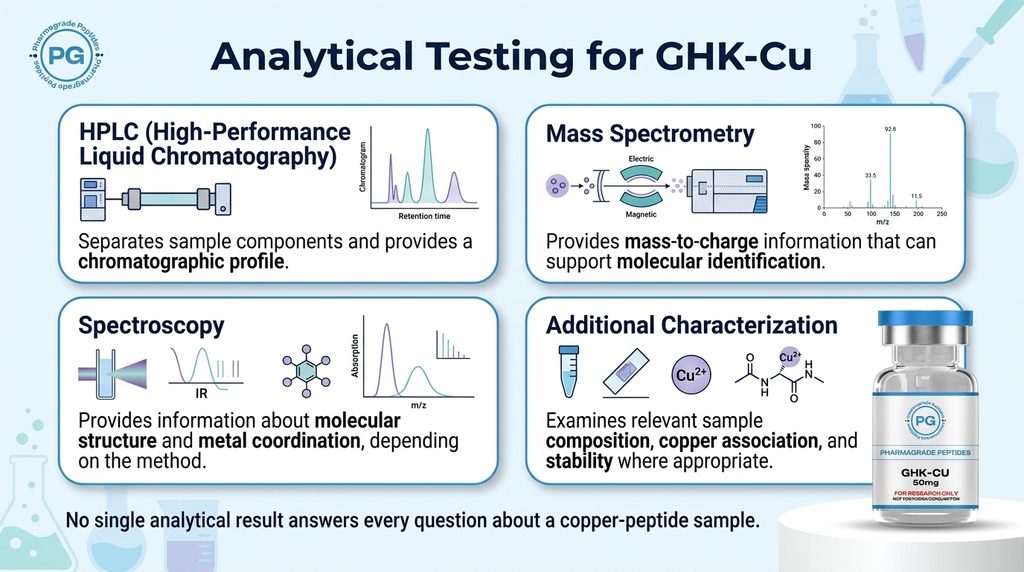
High-performance liquid chromatography
High-performance liquid chromatography (HPLC) separates components within a sample. Depending on the method and detection system, the resulting chromatogram can help researchers evaluate a sample’s chromatographic profile and estimate relative peak areas.
However, chromatographic purity is not the same as complete structural confirmation. A purity percentage alone does not necessarily establish the exact identity of every component, the amount of copper associated with GHK, or the stability of the complex under all conditions.
For this reason, HPLC results should be interpreted alongside the method details and other relevant analytical evidence.
Mass spectrometry
Mass spectrometry measures the mass-to-charge ratios of ions. It can provide information that supports molecular identity and helps researchers investigate sample composition.
Its usefulness depends on the analytical setup, sample preparation, ionization behavior, and the question being investigated. A mass measurement should not automatically be treated as proof of every structural feature or of the amount of copper coordinated under the original sample conditions.
Spectroscopic methods
Spectroscopic techniques can provide complementary information about molecular structure and metal coordination.
The structural literature on GHK-Cu illustrates why researchers may combine multiple methods rather than rely on one analytical result. Different techniques address different questions, and agreement between appropriate methods can provide a more complete picture of the material under investigation.
What should a research record include?
When evaluating research materials or published experiments, useful documentation may include:
- Clear identification of the peptide and its chemical form.
- Batch or sample identifiers.
- The analytical methods used and their limitations.
- Relevant chromatograms, spectra, or other supporting data.
- Information about copper content or coordination when that is material to the research question.
- Sample handling and stability information where available.
The precise requirements depend on the intended experiment. A generic purity statement cannot replace the analytical evidence needed to answer a specific research question.
GHK-Cu Research Limitations and Open Questions
Despite decades of investigation, important questions remain about how individual GHK-related chemical forms behave in different experimental systems.
Chemical identity across studies
Some publications focus on GHK, others on GHK-Cu, and others on formulations that combine copper peptides with additional materials. These entities should not be treated as equivalent without evidence.
Clearer reporting of the actual material tested would make it easier to compare findings across studies.
Stability and copper speciation
Researchers need to understand whether the copper-peptide complex remains chemically consistent under the conditions of an experiment.
Factors such as pH, competing ligands, storage conditions, and formulation ingredients may affect the species present. Future studies can strengthen interpretation by measuring relevant chemical changes instead of assuming that the starting material remains unchanged.
Translating preclinical findings
Laboratory and animal studies can reveal potential mechanisms, but they cannot independently establish clinical effectiveness or safety. Human research requires appropriate study designs, validated outcomes, and adequate reporting.
The relatively limited human evidence for GHK-Cu means that broad claims should be approached cautiously.
Standardization of analytical methods
Differences in sample preparation, analytical methods, reporting conventions, and formulation composition can make comparisons difficult.
More consistent reporting would help researchers determine whether different studies are examining the same chemical entity and whether apparent differences arise from the compound, the experimental model, or the analytical method.
What Future GHK-Cu Research May Examine
Several directions could help strengthen the scientific evidence base.
First, researchers can improve the characterization of copper-peptide complexes before and after experimental use. This would help establish whether the tested material remains consistent throughout the study.
Second, formulation studies can distinguish effects produced by the peptide complex from those produced by carrier materials. Suitable controls are essential for identifying the contribution of each component.
Third, researchers can report stability and analytical data in greater detail. This would make it easier to reproduce experiments and compare findings between laboratories.
Finally, future reviews and clinical investigations can clearly separate mechanistic evidence, preclinical results, and human outcomes. That distinction helps prevent promising early findings from being presented as established conclusions.
GHK-Cu and the Wider Field of Peptide Science
GHK-Cu is an instructive example of how peptide research extends beyond amino acid sequences alone. Its properties involve the interaction between a short peptide, a metal ion, and the surrounding chemical environment.
The available literature demonstrates that GHK-Cu has been studied through structural chemistry, computational modeling, cellular experiments, formulation research, and a limited clinical evidence base. Each research area answers a different set of questions.
For laboratory research, the most useful approach is to connect chemical identity with the experimental evidence. Understanding what material was tested, how it was characterized, and what the study actually measured is essential for interpreting results accurately.
As analytical and formulation methods develop, more detailed characterization may help researchers resolve unanswered questions about copper coordination, stability, and the reproducibility of experimental findings.
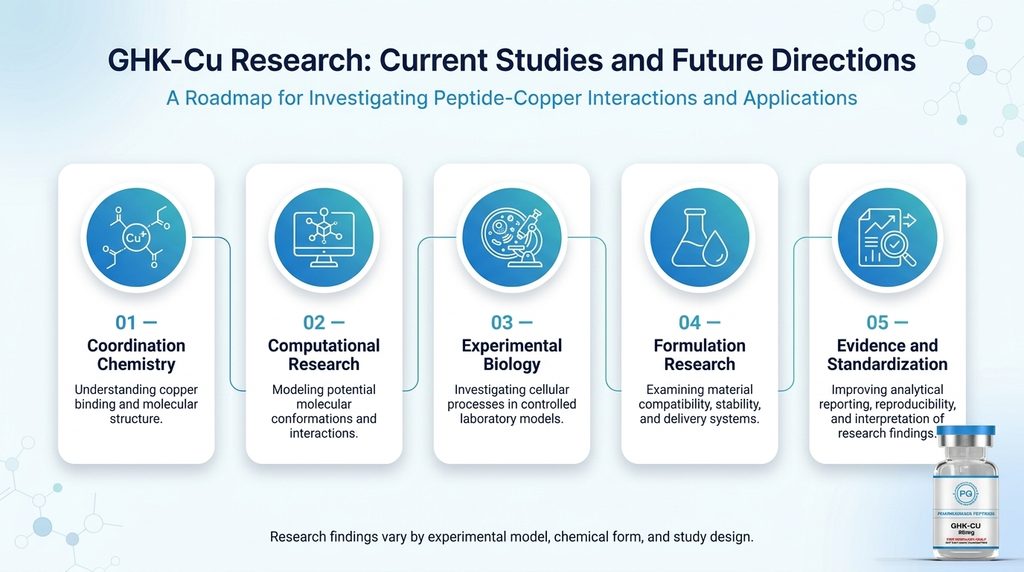
Research Peptides and GHK-Cu
Researchers evaluating GHK-Cu research materials should review the available product specifications and supporting analytical documentation in the context of their laboratory requirements.
PharmaGrade Peptides provides research-focused product information for customers evaluating peptide materials for permitted laboratory and scientific applications. Where available, relevant documentation should be assessed for sample identity, stated specifications, and the methods used to characterize the material.
For additional information, visit the GHK-Cu product page on PharmaGrade Peptides. Any product claims should be supported by appropriate documentation rather than inferred from published studies involving different formulations or experimental materials.
Research-use notice: Products are intended for research purposes only and are not intended for human or veterinary use. This article does not provide medical advice or instructions for administration.
Frequently Asked Questions
What is GHK-Cu in peptide research?
GHK-Cu is a copper-associated complex of the tripeptide glycyl-histidyl-lysine. Researchers study its coordination chemistry, molecular structure, and behavior in laboratory and preclinical systems.
What does GHK-Cu stand for?
GHK refers to glycine, histidine, and lysine, the three amino acids in the peptide sequence. Cu refers to copper, commonly present in the complex as copper(II).
How is GHK-Cu different from GHK?
GHK is the peptide itself. GHK-Cu refers to the copper-associated complex. Because their chemical forms differ, research findings involving one should not automatically be attributed to the other.
What methods are used to characterize GHK-Cu?
Researchers may use HPLC, mass spectrometry, spectroscopy, and other suitable analytical methods. Each technique provides different information, so the appropriate combination depends on the research question.
What does current GHK-Cu research investigate?
Research areas include copper coordination, molecular structure, cellular signaling, extracellular matrix biology, formulation science, and experimental delivery systems. The strength of evidence varies by topic, with much of the biological literature remaining preclinical.
Does laboratory research establish clinical effectiveness?
No. Laboratory experiments can help identify mechanisms and generate research questions, but they do not independently establish effectiveness or safety in humans. Clinical conclusions require suitable human studies and evidence.
Why does copper coordination matter when studying GHK-Cu?
Copper coordination helps define the chemical species being investigated. Changes in the surrounding environment or formulation may affect which species are present, so researchers should consider chemical characterization when interpreting experimental results.
Where can researchers find published GHK-Cu studies?
Useful sources include PubMed, peer-reviewed journals, and scientific databases. Original studies should be reviewed for their methods, experimental models, limitations, and conclusions rather than relying solely on summaries.
Conclusion
GHK-Cu remains an interesting subject in peptide science because its research combines coordination chemistry, molecular characterization, and biological investigation. Published work provides a foundation for understanding the copper-peptide complex, but important questions about chemical identity, formulation, stability, and clinical translation remain.
For PharmaGrade Peptides, this topic provides an opportunity to connect educational content about copper-peptide chemistry with research-focused product information while keeping scientific claims grounded in the available evidence.
Disclaimer: This content is for educational and research-information purposes only. PharmaGrade Peptides products are intended for laboratory research only and are not intended for human or veterinary use.
